The Opportunity I Almost Didn’t See

What I wish I had known about study abroad as a first-generation college student.
I was a first-generation college student studying Psychology at the University of Nevada, Las Vegas. Back in the early 2000s, when I was an undergrad, I never thought I could study abroad. Honestly, I didn’t really even know what study abroad was. So instead, I dedicated a good chunk of my young-adult life to traveling—on my own dime, sometimes on my own, and sometimes with colleagues for conferences.
My first international trip was with my dad to the island of Terçeira in the Açores, off the coast of Portugal — I was 18 or 19. I ate a lot of octopus soup—I can still remember the little suckers floating around in it. I remember walking through the hills, the eucalyptus trees, the galão that were sort of like a cafe latte, and the bread, butter, and cheese sandwiches. That trip made me fall in love with travel—even if the water turned off at the most random times, even when you were mid-shampoo rinse. The things that weren't working, made it so much more interesting because I came to appreciate the differences and things in life a little more.
It Wasn’t Just the Places
Don’t get me wrong. My trips to Germany, the Netherlands, France, Spain, Thailand, England, Ireland, and beyond have been amazing. But when I think about some of my favorite travel memories, many of them aren’t really about the places I went. They’re about the people I was with. The first time I went to the Netherlands (Amsterdam), I gave my very first conference talk in a room with about 100 other academics.
Terrifying? Yes.
But that evening, a big group of us went to dinner. We laughed, told stories, talked about science, and just spent time together. That experience made me fall in love with a different part of travel: the community you build when you experience a place together.
And somewhere along the way, I learned something else about myself. I don’t particularly like doing all the touristy stuff. Will I go to a museum? Sure. There are incredible things in museums that I absolutely want to see. But I don’t want to spend an entire trip racing from one attraction to another just because someone says those are the things I’m supposed to see.
What I love most about travel is getting to feel, even briefly, like I live somewhere else. I like walking around. Finding the coffee shop. Figuring out where I’m going. Watching people interact. Eating somewhere I stumbled across rather than somewhere on a list. I even get a little excitement from being uncomfortable and then figuring out how to navigate that discomfort.
Because that’s when I start learning.
Do I Regret Not Studying Abroad?
Yeah. I think I do. Now that I’m a faculty member leading study-abroad programs, I’ve realized something I couldn’t have understood when I was 20:
It’s not just the place that makes the experience. It’s the people you experience it with.
Every time a new group of students comes to study with me, I learn something new. There is a built-in community when you study abroad. You have people to explore with, eat with, figure things out with, get lost with, and laugh about it with later (and sometimes argue). And that matters because travel can also be overwhelming.
New transportation. New food. Different customs. Different expectations. Maybe a language you don’t speak. Even simple things that you never think twice about at home can suddenly require some figuring out (laundry soap, for example).
Study abroad gives you a structure for doing that. You have a place to live. You have faculty there. You have other students going through the same experience. Some things are planned for you, but there is also room to explore. That little bit of structure can give you the comfort and safety to venture farther outside your comfort zone. And eventually, the unfamiliar starts becoming familiar.
Let the Place Teach You
Do I know Florence? Sure. I’ve spent a lot of time there. Do I love it? More than any other place on earth, but I think Italy in general is special.
But even though I spend a lot of summers there, I have made forever friends (Riccardo and Ervi)—I don’t live there, and I’m certainly not going to pretend that I can teach students how to be Florentine.
Instead, Florence and Italy teaches me something new every time I go.
The city gives us this extraordinary place where the past and present are layered on top of one another. Standing on a corner, waiting to cross, realizing one of the greats likely stood in this very spot. Do you have chills yet? That's what happens to me. The best part is, when we have the chance, we get to pay attention to what happens when we step outside the culture we already know.
We walk. We talk. We eat together. We get confused. We figure things out. We notice things we might never have noticed at home. We dolce far neinte. And every group experiences the city differently. That’s one of my favorite parts of leading these programs. I may return to the same place, but I don’t have the same experience twice.
The students make the experience new.
So, Should You Study Abroad?
If you’re starting to think about study abroad and wondering whether you should do it, can you wait like I did and travel later? Of course you can. Would I recommend waiting? Probably not. I got lucky. In a strange way, I got a second chance. Every year, my students let me experience a little piece of the college that I didn’t take advantage of myself. But I also know why some students hesitate—because I did.
Maybe you’re worried about money. Maybe you’ve never traveled internationally. Maybe nobody in your family has done something like this before. Maybe the thought of landing in another country sounds exciting and terrifying at exactly the same time. Those are reasons to ask questions. They aren’t reasons to automatically tell yourself no.
Find out what the program actually costs. Ask about scholarships and financial support. Find out what is included. Talk to someone who has done it. Ask the questions before deciding that the opportunity isn’t for you. Maybe you’ll decide it isn’t. That’s okay. Just don’t make the decision before you know what’s possible.
Walk Through the Living Museum
Maybe you will decide, this time, yes, I am going to do it. I once told my sister, when we were planning one of our trips:
Why pack every day with museums when walking through the city is literally like walking through a living museum?
I still believe that. When we go to Florence, we’ll learn some things. Of course we will. But we’ll also walk around. We’ll eat together. We’ll probably get turned around a few times. We’ll encounter things we don’t understand. We’ll become more comfortable with things that initially felt unfamiliar. And somewhere in all of that, we’ll learn from each other. Because sometimes the best part of travel isn’t checking off everything you’re supposed to see.
It’s giving yourself enough time to notice where you are—and who you’re there with. I hope you come join me in Florence sometime.
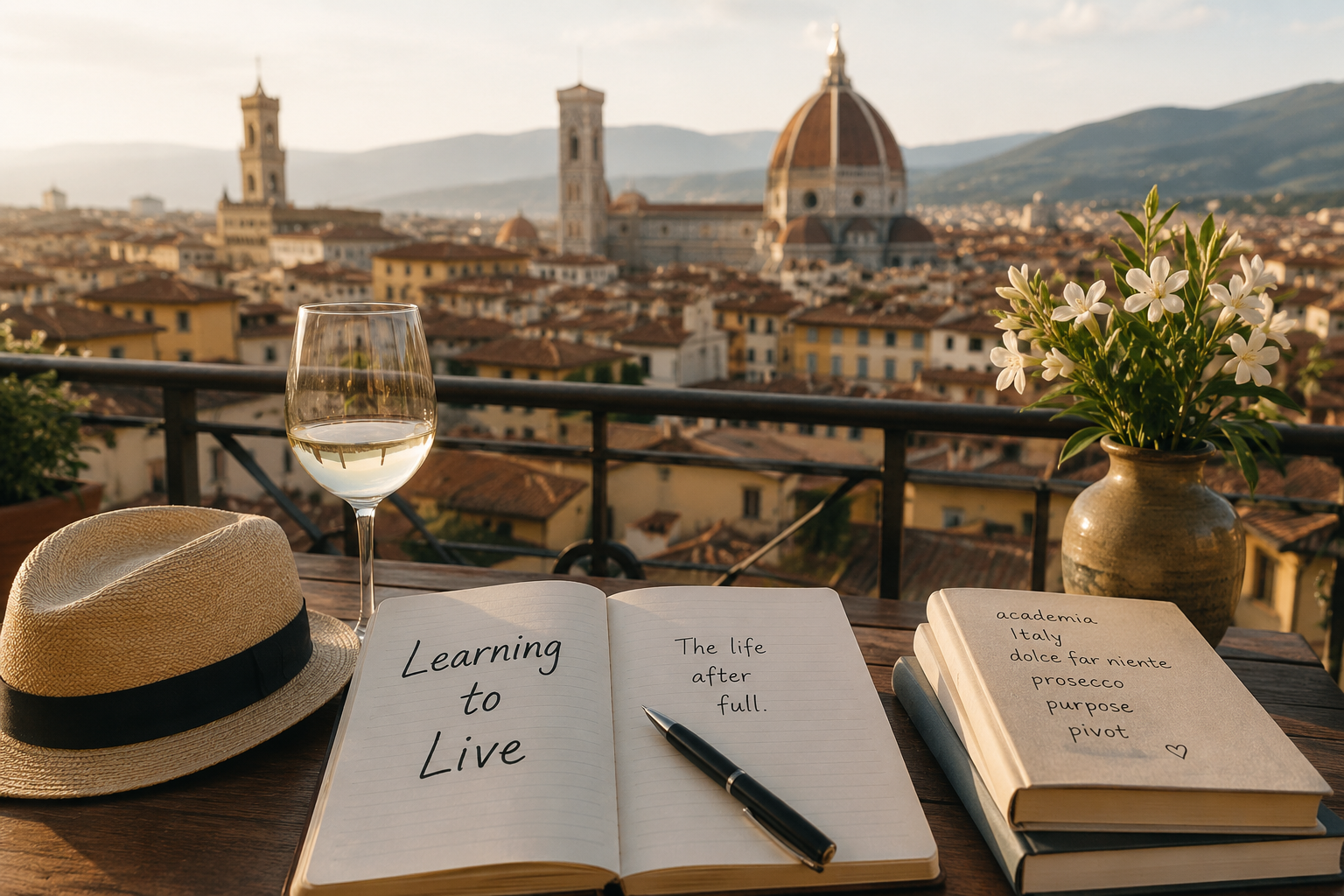
Relearning to Live: Thank you Florence

Full Professor is one of those academic milestones that can quietly expose a strange question—Okay, I climbed this mountain, now what? The answer doesn’t have to be another mountain.
I am 44 years old, starting my twelfth year as a professor, and I feel like I haven’t stopped moving since I was an undergraduate. I was a first-generation college student and a transfer student in the early 2000s, which meant I entered academia without much of a roadmap. Back then, transfer students were largely left to figure things out on their own, and college came with a huge learning curve. There were rules I didn’t know, opportunities I didn’t know I should be looking for, and an entire language of higher education I had to learn as I went. But I did it.
And somewhere along the way, I found a mentor who changed the trajectory of my life. He saw something in me before I really knew how to see it in myself. He helped me recognize that I was capable of more than I thought I was, and I followed him into my master’s program. That doesn’t mean the road suddenly became easy.
Graduate school taught me some painful lessons about what happens when you are young, green, and haven’t yet learned to trust your own abilities. I encountered people who made me question whether I belonged there at all. But I also started learning one of the lessons that would become central to my career: sometimes the path forward requires a pivot.
My PhD advisor taught me how to be an academic. He taught me to love learning for the sake of learning—to follow questions because they were interesting, not simply because they produced something measurable. My postdoc was another crash course in I am definitely not smart enough to be here. But it also gave me a microscope. It taught me how to look closely, how to pull questions apart, and, eventually, how to figure out which questions were actually mine.
Then I became an assistant professor, struggling again in the pre-tenure life. Five years of wondering if I was going to have a job at the end of it. And once again, I had to find my footing. I came into my academic home from a somewhat different intellectual tradition than many of the people around me. Sometimes that difference was celebrated; sometimes it made belonging more complicated. I learned to navigate it. I built collaborations. I taught. I published. I mentored students. I earned tenure.
Then there was a pandemic. The world closed. I took naps that week while we figured out what to do—probably the best gift I could have gotten post-tenure. But then reality hit, and my workload grew. For a while, I taught more than I thought I was capable of teaching and worked more than I thought I was capable of working. And still, I kept climbing.
Six years later, I made it to the last stop, the last promotion. I made it to Full Professor.
All along the way, as I took the path forward, something unexpected happened. I found Florence.
Florence didn’t interrupt my climb. In many ways, it gave me the strength to make it through the last few hurdles. I was still working, still publishing, still teaching, still saying yes to too much. But somewhere along those cobblestone streets, Florence began teaching me something I had never been particularly good at: how to live while still climbing.
It taught me to savor my food and linger at dinner. To walk without needing to get somewhere. To sit in a piazza and simply watch the world move around me. To appreciate the beauty without needing to turn it into something productive. And the most amazing thing happened: I felt happier, my health improved, and I became more creative.
I haven’t come home less ambitious. I come home after each summer understanding that ambition and living don’t have to be mutually exclusive. Florence taught me how to climb better, and when I reached Full, I realized Florence had been quietly teaching me what to do when I got here.
Stop looking for the next mountain. Look around. And enjoy and grow what you have.
There is something freeing about being an academic who finally gets to say: I have learned a lot, and now I get to share what I know. I get to return to what I loved about graduate school—dreaming, thinking, exploring simply for the sake of knowing more, and maybe moving the world forward one tiny piece at a time.
And so, this is my first blog post. I have no idea where this crazy life will take me next, but I think that’s the point. I spent a long time learning how to climb. Now, let’s see what happens as I learn to look around.
© 2026 Jenny Roche. All rights reserved.